What you need
A standard 52-card deck, 2 to 6 players (2 to 4 is best), and something to keep score on. Our printable score sheet has room for six players over many deals.
Cards rank from ace (low) up to king. In basic Rummy the ace is low only: A-2-3 is a run, Q-K-A is not.
Setup
Deal one card at a time, face down:
- 2 players: 10 cards each
- 3 or 4 players: 7 cards each
- 5 or 6 players: 6 cards each
Turn the next card face up to start the discard pile and put the rest face down beside it as the stock. Before the first deal, agree how the game ends: a target score (100 or 200 points are common) or a fixed number of deals.
How to play
The player to the dealer’s left goes first (the non-dealer, with two players). Play goes clockwise. A turn has three parts, in order.
1. Draw
Take the top card of the stock or the top card of the discard pile and add it to your hand.
2. Meld and lay off (optional)
You may lay a combination from your hand face up on the table. Two kinds of combination, called melds, are valid:
- a run (sequence): three or more cards of the same suit in order, such as 4-5-6 of hearts
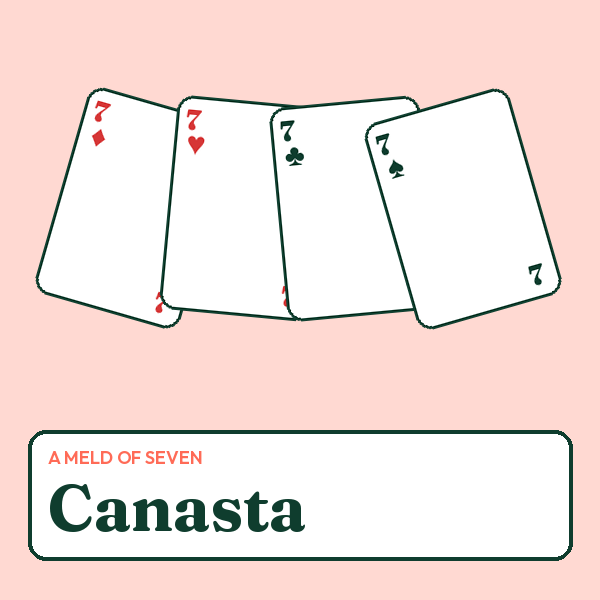
- a set (group): three or four cards of the same rank, such as three 7s
You may also lay off: add cards from your hand to any meld already on the table, yours or anyone else’s. A fourth 7 goes on a set of 7s; the 3 or the 7 of hearts goes on 4-5-6 of hearts. You cannot move cards between existing melds to make room.
Melding is never compulsory. Pagat’s basic rules allow one meld per turn; Bicycle’s allow any number. Pick one before you start.
3. Discard
End your turn by putting one card face up on the discard pile. If you took the top discard this turn, you may not put the same card straight back.
If the stock runs out and the next player does not want the top discard, turn the discard pile over (without shuffling) to make a new stock.
Scoring and winning
The deal ends the moment a player gets rid of their last card by melding, laying off or discarding. This is called going out. Nobody else may meld after that.
Each other player adds up the cards left in their hand: face cards 10 points, aces 1 point, number cards face value. The total goes to the winner.
Going rummy. If you go out in a single turn, having never melded or laid off before, the hand counts double.
Play further deals until someone reaches the agreed target. The first player to reach it wins.
Common variants
- Aces high or low. Q-K-A becomes a legal run and aces count 15 points instead of 1.
- Discard to go out. Some groups require your last card to be a discard; you cannot meld your entire hand and leave nothing to throw.
- No laying off before you have melded. You must have at least one meld of your own on the table before adding to other people’s.
- Block Rummy. The discard pile is never reused. When the stock runs out and the next player refuses the discard, the deal ends and everyone scores the cards in hand; the lowest hand wins the differences.
- Penalty scoring. Losers record the points in their hands as penalties; when someone passes 100, the lowest score wins.
Tips for first games
- Watch the discards. If your opponent picks up a 9, stop throwing 9s and the cards around them.
- Shed high cards early. A king stuck in your hand at the end costs 10 points.
- Melding early is safe but tells everyone what you are collecting. Holding back for a “rummy” doubles the score but risks a big loss if someone else goes out.
Frequently asked questions
How many cards do you get in Rummy? Ten each for two players, seven for three or four, six for five or six.
Can you pick up the whole discard pile? Not in basic Rummy, only the top card. Taking several cards from the pile is a feature of 500 Rum, which many people also call Rummy.
Can an ace be used both high and low? In the standard game the ace is low only. Playing “aces high or low” is a popular house rule; agree on it beforehand.
Do you have to discard if you meld all your cards? Under the usual rules, no: melding or laying off your last card ends the hand. Some groups insist on a final discard.
What is “going rummy”? Going out in one turn without having melded before. Your score for that hand is doubled.